

Single Stock Perpetual Futures: A Courtroom Fight Over Access, Money and Power
Developments as of November 23, 2026
By Matt Hamilton
Key Takeaways
There is a federal court conflict over a new financial product that lets ordinary investors speculate on individual stock prices without buying the stocks. The product is called a single-stock perpetual future.
The controversy comes down to several questions.
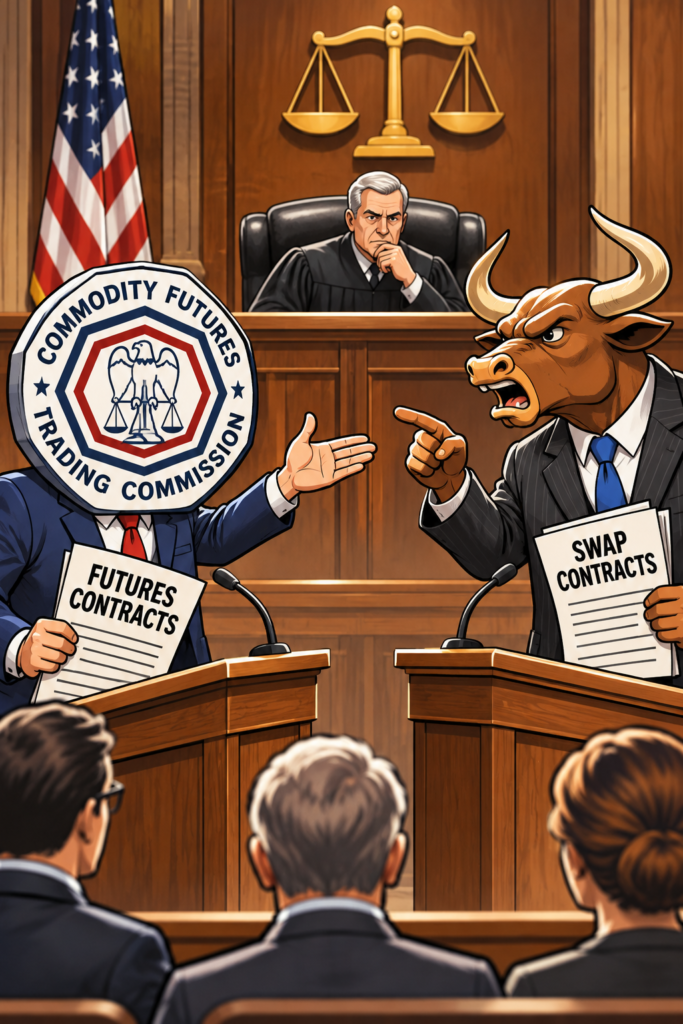
- Who should regulate single-stock perpetual futures? The Commodity Futures Trading Commission (CFTC) argues that these products are security futures, subject to joint regulation by the CFTC and Securities and Exchange Commission (SEC). The Capital Markets Alliance Association argues they are security-based swaps, subject to a different and more restrictive SEC-centered regulatory framework.
- What does the lawsuit seek? The Alliance, whose members include Cboe Global Markets and Citadel Securities, wants to stop the November 2026 CFTC approval of single stock perpetual futures. The Alliance argues that the CFTC is violating federal law and exposing investors to unnecessary risk. Its members face competition that could reduce their trading revenue and market share.
- What does the CFTC appear to want? The CFTC presently seeks to preserve its approval and allow these contracts to trade on regulated American exchanges. It argues that existing law permits the products and that bringing them into U.S. markets is preferable to leaving traders dependent on offshore platforms.
- What has the court decided? On November 3, 2026, a federal judge denied the Alliance’s request for an immediate trading halt. The court tentatively found that the Alliance was likely to succeed on its central legal argument. This preliminary finding is not a final ruling. Further litigation appears a near certainty with authority over this important financial product hanging in the balance.
- Why does this lawsuit matter? The outcome could change how Americans trade stock-linked derivatives, who earns the fees from those trades, which federal regulators control the market, and the protections available to retail investors. The dispute also raises a larger question: Can financial companies change the regulatory treatment of an investment by changing its contractual design?
Understanding Futures, Forwards, Swaps and Perpetual Contracts
What Is a Futures Contract?
A futures contract is a legally binding agreement to buy or sell an asset at an agreed price for performance or settlement in the future. The underlying asset may be wheat, crude oil, gold, a stock, a stock index, a currency, or another financial interest.
- Consider a wheat farmer who expects to harvest 10,000 bushels in September. In May, wheat sells for $6 per bushel. The farmer fears that the price will fall before harvest. The farmer sells futures contracts for 10,000 bushels at $6 per bushel for September delivery. If September wheat prices fall to $5, the farmer loses $10,000 in the cash market but can make approximately $10,000 on the short futures position, before fees and other adjustments. If wheat prices rise to $7, the farmer earns more from selling the crop but loses approximately $10,000 on the futures position. In either case, the farmer has substantially reduced exposure to changes in the market price.
This is called hedging. The farmer sacrifices some possible profit in exchange for greater price certainty.
Not every futures trader owns the underlying asset. A speculator may purchase wheat futures because he believes wheat prices will rise. He may sell the contract before expiration and never touch a bushel of wheat.

Modern futures contracts ordinarily trade on organized exchanges. They are standardized, subject to margin requirements, and commonly cleared through a clearinghouse. Gains and losses are credited or debited through a process called marking to market. Although some contracts permit physical delivery, most speculative positions are closed before delivery. Other futures contracts are designed for cash settlement. The distinction between an obligation for future performance and the actual delivery of an asset is central to the current litigation.
How Do Futures Differ From Forwards and Swaps?
Futures, forwards and swaps are derivatives. A derivative obtains its value from another asset, price, rate or financial measure. They differ principally in how the agreements are structured, traded, and performed.
A forward contract is generally a privately negotiated agreement to buy or sell an asset at a specified future date for a price agreed upon today. A grain company and a farmer might agree privately that the company will purchase 10,000 bushels of corn on October 1 for $5 per bushel. The parties negotiate their terms directly. The agreement usually is not traded on a conventional futures exchange. They bear counterparty risk, meaning the risk that one party will fail to perform. Some forwards are collateralized or otherwise subject to interim payment arrangements. The distinction is not absolute.
A futures contract generally standardizes the quantity, quality, trading unit, settlement procedures and other important terms. It trades through an exchange and ordinarily uses a clearinghouse that becomes the counterparty to cleared transactions. Margin and settlement procedures reduce, but do not eliminate, counterparty risk.
A swap contract ordinarily provides for an exchange of payments based on a financial reference, such as an interest rate, commodity price or stock value. Suppose a company has a loan with a variable interest rate. It enters into a swap under which it pays a fixed rate and receives payments based on a floating rate. The swap can reduce the company’s exposure to rising interest rates without changing the underlying loan. An equity swap might provide payments based on the increase or decrease in a company’s stock price, possibly including the economic equivalent of dividends, without transferring ownership of the shares.
Swaps may be privately negotiated or standardized. Some are centrally cleared and traded on regulated venues. The distinction between futures and swaps is therefore not simply exchange trading versus private trading. Commercial hedgers, financial traders and swap dealers can participate in both markets. Dealers frequently offset their swap exposures with futures transactions. The two markets are economically connected even when different legal rules govern them.

What Is a Perpetual Futures Contract?
A perpetual futures contract, commonly called a “perp,” is a derivative designed to track the price of an underlying asset without a fixed expiration date. A conventional futures contract might expire on the third Friday of December. A perpetual contract does not expire merely because a stated calendar date arrives. A trader can maintain the position indefinitely, provided he satisfies margin requirements, pays applicable costs, and avoids liquidation or other contractual termination events.
Perpetual contracts are generally cash-settled. They provide economic exposure to an underlying asset without transferring ownership of that asset. Perps originated as a commercial trading product in cryptocurrency markets, although the concept of perpetual financial claims predates cryptocurrency. The basic attraction is simple. An investor can speculate on an asset’s price, take a short position, or hedge an existing investment without buying the asset and without repeatedly replacing an expiring futures contract.
How Do Perpetual Contracts Work Without an Expiration Date?
Traditional futures prices ordinarily converge toward the underlying asset’s spot price as expiration approaches. Perpetual contracts have no expiration date to produce that result. They therefore use another mechanism to encourage their trading price to remain close to the underlying asset’s price. That mechanism is called the funding rate.
The funding rate determines periodic payments between traders holding long positions and traders holding short positions. Consider a stock trading at $100 per share. A perpetual contract referencing that stock is trading at $102. The exchange’s funding formula may require traders holding long positions to pay traders holding short positions. The payment encourages traders to sell the relatively expensive perpetual contract and may push its price toward $100. If the perpetual contract instead trades at $98, the funding mechanism may require short positions to pay long positions. That arrangement encourages buying and can help move the perpetual price back toward the stock price.
Funding calculations may occur hourly, every eight hours, or according to another schedule specified by the exchange. Funding payments are distinct from profits and losses caused by changes in the contract’s market price.
- A trader can correctly predict the movement of a stock and still lose money on a perpetual contract if funding costs, fees and other expenses exceed the trading profit.
Funding does not guarantee that the perpetual price will equal the underlying price. Market stress, thin liquidity, unreliable price references and trading interruptions can produce substantial differences. The absence of a fixed expiration date, together with recurring funding payments, creates the legal controversy.
Is a Perpetual Contract Actually a Futures Contract?
Economically, perpetual contracts and traditional futures have many similarities.
- Both provide exposure to future changes in an asset’s value.
- Both permit long and short positions.
- Both can use leverage, margin, exchange trading, centralized clearing and cash settlement.
But the legal question is not answered by their similarities. Federal law defines a security future by reference to a contract of sale for future delivery. It separately defines swaps through contractual payments that transfer financial risk. A perpetual contract can resemble both.
- For example, in the Capital Markets Alliance v. CFTC case, the CFTC contends that a fixed expiration date is not an essential legal requirement for every futures contract. It argues that a perpetual contract remains a future because the parties undertake obligations involving future cash settlement. Conversely, the Alliance (the plaintiff) argues that future delivery is an essential element of a future. A perpetual contract that has no expiration date and no mandatory future delivery or final settlement obligation is therefore not a security future.
The label used by the exchange cannot resolve that dispute. The court will examine the legal definition, the actual contract, its economic function, and the obligations imposed on the parties.
The Perpetual Futures Market
How Large Is the Perpetual Futures Market?
Perpetual futures are one of the largest products in the international cryptocurrency derivatives market.
- The American Action Forum’s November 13, 2026, primer reports approximately $62 trillion in cryptocurrency perpetual futures trading volume during 2025, compared with approximately $18.5 trillion in cryptocurrency spot trading.
- Reuters and CryptoQuant, report a similar $61.7 trillion figure for cryptocurrency perpetuals in 2025.
- CoinGecko’s State of Crypto Perpetuals Report 2026 reports a larger figure of approximately $85.3 trillion in 2025 trading volume on centralized perpetual exchanges.
These figures come from different datasets and coverage methodologies. They should not be treated as identical measures. A trading volume of $62 trillion does not mean that $62 trillion of investor capital was deposited in perpetual futures accounts. Volume measures the notional value of transactions over time. The same capital can support repeated transactions, particularly when leverage is used. Open interest, which measures outstanding contracts or positions, is a different statistic.
The market for perpetual contracts referencing traditional financial assets is also growing. CoinGecko reported that trading in tokenized equity perpetuals across the exchanges it studied reached approximately $34 billion in May 2026. Its broader category of traditional-finance perpetuals exceeded $1.32 trillion in trading volume during the first five months of 2026. That broader category includes products other than individual stocks.
These numbers also describe largely international markets. They should not be mistaken for trading volume on regulated American single-stock perpetual exchanges. The U.S. market is comparatively new. Its November 2026 launch makes reliable long-term comparisons difficult.
What Assets Can Become the Subject of a Perpetual Contract?
A perpetual contract can theoretically reference almost any asset or financial measure for which a reliable price or settlement methodology can be established. Existing or proposed products involve cryptocurrencies, individual stocks, exchange-traded funds, broad stock indexes, narrow-based indexes, gold, silver, energy commodities, foreign currencies, and other financial interests. Some offshore platforms offer derivatives referencing tokenized assets and the estimated values of privately held companies.
A product’s economic feasibility does not establish its legal permissibility. A contract referencing Bitcoin may fall under one regulatory framework. A contract referencing Apple common stock may fall under another. A contract referencing a broad stock index may receive still different treatment.
The applicable rules depend on the asset, contractual terms, trading venue and statutory definitions. For privately held companies or thinly traded assets, determining a trustworthy reference price can be especially difficult.
Who Benefits From Perpetual Futures?
Various types of persons and businesses are profit-making stakeholders in perpetual futures.
- Individual traders obtain access to leveraged price exposure. They profit from rising or falling prices without acquiring the underlying asset.
- Hedgers use perpetual contracts to reduce an existing exposure. A shareholder concerned about a temporary decline in a stock can establish a short position in a stock-linked derivative rather than selling the shares.
- Market makers earn trading spreads and, depending on their positions and funding arrangements, receive funding payments or other trading income. Market-makers provide liquidity by posting prices at which they are willing to buy or sell.
- Exchanges earn transaction fees, clearing-related revenue, market data revenue, and other fees associated with listing and trading.
- Brokers and futures commission merchants earn commissions, financing income or fees for providing customer access, holding collateral and servicing accounts.
- Clearinghouses earn fees for clearing transactions and managing counterparty obligations.
- FinTech companies attract customers who want access to stocks, commodities and cryptocurrency derivatives through a single electronic trading platform.
- Institutional investors and arbitrageurs exploit price differences between perpetual contracts, ordinary futures and underlying securities, although arbitrage opportunities involve execution, funding and market risks.
The same structure that creates those opportunities creates the principal investor danger: a relatively small market movement can produce a large loss on a leveraged position.
How Single-Stock Perpetual Futures Are Traded
How Does an Investor Buy or Sell a Single-Stock Perpetual?
The buying-selling process resembles electronic derivatives transactions. A customer establishes an account with an eligible intermediary or platform, completes the required verification, and trading authorization procedures, and deposits collateral. The customer chooses an underlying stock and decides whether to take a long or short position. A long position generally gains value when the stock-linked contract price rises. A short position generally gains value when the price falls. The customer’s order is submitted under the trading rules of the relevant exchange.
Where the contract is centrally cleared, the clearinghouse manages obligations between clearing participants. The customer’s intermediary manages the customer’s margin account, subject to applicable rules. The exchange calculates settlement values and funding adjustments. The intermediary applies the resulting gains, losses and charges.
To exit, the customer ordinarily enters an offsetting transaction or otherwise closes the position under the contract’s rules. Because different exchanges use different contract units, a customer must examine the specifications rather than assume that one contract represents one share.
- For example, Kalshi’s customer materials describe fractional contract exposure. A group of contracts may represent the price exposure of one underlying share.
Other exchange filings use a standardized 100-share contract unit while permitting fractional trading increments. The exact contract multiplier affects profit, loss, margin and liquidation calculations.
How Does Leverage Change an Investor’s Risk?
Suppose an investor establishes a perpetual futures position representing $10,000 of stock exposure. Assume the initial margin requirement is 15 percent. The investor deposits $1,500 in collateral. If the stock-linked contract price falls by 5 percent, the position loses approximately $500, before funding payments and fees. The stock price declined only 5 percent, but the investor lost approximately one-third of the initial collateral.
A 10 percent adverse movement would produce approximately $1,000 in losses, consuming about two-thirds of that collateral. If the investor cannot maintain the required margin, the position may be liquidated before any later recovery in the stock price.

The federal minimum margin framework for security futures generally requires at least 15 percent, subject to applicable rules and potentially higher exchange or intermediary requirements. That minimum was developed under joint SEC and CFTC regulation. It is not an unrestricted authorization for every leverage ratio offered in offshore cryptocurrency markets.
An investor also must understand that liquidation can occur while the underlying securities market is closed or while funding transfers are unavailable. The practical questions are not merely whether the investor can predict a price movement. They include whether the investor can finance the position, withstand temporary losses and avoid involuntary liquidation.
How Does a Single-Stock Perpetual Purchase Differ from Buying Stock?
When an investor purchases common stock, the investor acquires an ownership interest in the issuing company. That ownership ordinarily carries voting rights and may include rights to dividends and a residual claim on company assets.
A perpetual futures position provides economic exposure to the stock’s price without conferring ownership. The holder does not become a shareholder merely by entering the contract. The holder ordinarily does not receive shareholder voting rights, direct dividends or ownership of corporate assets. The contract may incorporate adjustments intended to account for dividends, stock splits or corporate actions. Those adjustments are contractual rights, not direct shareholder rights.
A stock investor can lose the amount invested if the stock becomes worthless. A leveraged derivatives trader can lose collateral much more rapidly and, depending on the contract and intermediary arrangements, face further payment obligations. Unlike an ordinary stock purchase, the derivative also creates funding-rate exposure, liquidation risk, clearing and intermediary risk, and possible differences between the contract price and the underlying stock price.
How Does a Single-Stock Perpetual Differ From Gambling?
Economically, speculation in a perpetual contract resembles a wager on the future price of an asset. An investor predicts whether a stock price will rise or fall and commits money to that prediction. But economic resemblance does not establish a legal classification.
A futures contract can serve the legitimate commercial purpose of transferring financial risk. A farmer, manufacturer, investment fund or shareholder can use derivatives to hedge exposure. The same contract can be used by another participant solely for speculation.
Better Markets, a financial-reform advocacy organization, has described single-stock perpetuals as another gambling product. Its criticism emphasizes leverage, the potential for rapid liquidation, and the absence of stock ownership. That criticism addresses real economic risks.
But a derivative does not become unlawful gambling merely because the purchaser intends to speculate. Legal treatment depends on the federal and state laws, the characteristics of the transaction, and the statutory authority governing the product.
There is also a distinction between a casino wager and a centrally cleared exchange-traded derivative. An exchange may match independent buyers and sellers instead of accepting the opposite side of each customer wager. That distinction does not eliminate conflicts of interest. Some trading structures permit affiliated liquidity providers, and concentrated market making can create additional concerns. The better question is whether the instrument satisfies the legal requirements governing the market in which it trades.

The American Regulatory System
How Does the United States Regulate Perpetual Futures?
Before 2026, perpetual futures were principally associated with offshore cryptocurrency markets and were not approved for listing on regulated U.S. exchanges. On May 29, 2026, the CFTC approved a bitcoin perpetual futures contract proposed by KalshiEX. The CFTC also issued a policy statement explaining its approach to perpetual contracts.
That action did not automatically authorize perpetual contracts on every commodity or financial asset. The CFTC recognized that different underlying markets raise different questions concerning pricing, trading, clearing and manipulation.
In June 2026, the SEC and CFTC sought public comment on the definition and regulatory treatment of certain derivatives, including equity-linked perpetuals. By September, several exchanges were proposing security futures products involving individual stocks. The CFTC permitted three challenged applications to become effective through its regulatory review process.
On November 3, 2026, CFTC Chairman Michael S. Selig announced that equity perpetual contracts could begin trading on eligible exchanges. The legal framework of the product type will depend upon the classification:
- A cryptocurrency perpetual classified as a commodity future is primarily regulated under the Commodity Exchange Act.
- A single-stock perpetual classified as a security future is subject to the statutory framework for security futures and joint SEC-CFTC regulation.
- A perpetual classified as a security-based swap is subject to the SEC-centered statutory framework applicable to those instruments.
Each product’s classification will affect its listing, registration, customer access, disclosures, margin, surveillance, recordkeeping and enforcement.

What Is a Security Futures Contract?
A security future is a futures contract involving a single security or a narrow-based securities index. It is defined by the Commodity Exchange Act in 7 U.S.C. § 1a(44). The Securities Exchange Act contains a corresponding definition in 15 U.S.C. § 78c(a)(55). A security futures product includes security futures and certain options on those futures.
A conventional single-stock future may track 100 shares of a company and settle on a stated expiration date. Unlike a purchase of common stock, the buyer obtains exposure through a derivative contract. Security futures are unusual because they are regulated under both securities and commodities law.
- The CFTC’s published Security Futures Products Overview explains that designated contract markets may trade security futures if they satisfy the relevant requirements and notice-register with the SEC.
Securities exchanges may also participate through the corresponding registration framework. Intermediaries handling these products are subject to dual-registration or notice-registration requirements, as applicable.
The Effect of the Commodity Futures Modernization Act of 2000
Congress enacted the Commodity Futures Modernization Act of 2000, or CFMA, as part of Public Law 106-554. The statute changed several important features of U.S. derivatives regulation. The CFMA will materially affect the Capital Markets Alliance lawsuit result. The CFMA permits single-stock futures to trade in the United States. They were previously prohibited.
The CFMA establishes a framework for joint regulation by the SEC and CFTC. The distinction matters because the SEC has never possessed exclusive authority over every derivative involving an individual stock. Single-stock futures traded in the United States for years after enactment of the CFMA.
- OneChicago operated a single-stock futures market beginning in 2002 and ultimately ceased operations in 2020.
The prior existence of single-stock futures does not answer whether a perpetual contract qualifies as one. It does, however, defeat the proposition that Congress categorically prohibited futures referencing individual stocks. The dispute in the Capital Markets Alliance lawsuit is a dispute is over whether the new perpetual structure fits within the security futures category Congress established.
The Effect of the Dodd-Frank Act
The Dodd-Frank Wall Street Reform and Consumer Protection Act of 2010 expanded federal oversight of swaps after the 2008 financial crisis. Congress divided regulatory responsibility primarily between the CFTC for swaps and the SEC for security-based swaps.
A security-based swap generally involves specified payment or risk-transfer arrangements based on a single security, a narrow-based securities index, or certain other securities-related references. The definition appears in 15 U.S.C. § 78c(a)(68). The Commodity Exchange Act defines swaps broadly in 7 U.S.C. § 1a(47).
One important feature is that the swap definition excludes certain transactions that are properly classified as futures or security futures. That creates a threshold classification problem. A court must determine whether the disputed contract qualifies as a security future before determining whether the security-futures exclusion removes it from the swap framework. If it does not qualify as a security future, its structure may place it within the statutory security-based swap definition.
Dodd-Frank also imposed registration, reporting, business conduct, clearing and other requirements on covered swaps activity. Security-based swaps offered to persons who are not eligible contract participants face restrictions, including requirements involving registered exchanges and securities registration. Those requirements are not identical to those applicable to security futures. The difference has significant consequences for access by ordinary retail investors.
The Major Players in the Single-Stock Perpetual Futures Market
Exchanges and Market Makers, mainly
The international perpetual futures market includes several major cryptocurrency trading businesses. Binance and OKX are among the largest centralized cryptocurrency derivatives venues. Bybit, Bitget, MEXC and Gate also participate significantly in these derivatives markets.
Hyperliquid is a major decentralized perpetual trading platform. Other decentralized venues compete for cryptocurrency and traditional-asset derivatives activity. Rankings differ according to the reporting period, product category, trading volume and open interest.
The equity-linked perpetual market has its own competitive structure. CoinGecko identified Binance, MEXC and Hyperliquid as leading venues in its 2026 study of traditional-finance perpetuals.
The American market includes a different group of companies operating within, or seeking access to, U.S. regulatory frameworks.
- KalshiEX is a CFTC-regulated exchange known for prediction markets and newer perpetual futures products. It launched single-stock perpetual trading in November 2026.
- Coinbase Derivatives operates a regulated U.S. derivatives exchange and submitted applications to list equity perpetual contracts.
- Bitnomial Exchange is another regulated derivatives exchange whose equity perpetual applications became effective through the CFTC review process.
- Payward, associated with Kraken, has supported the defense of equity perpetuals and has interests in the derivatives infrastructure involved in the controversy.
Other exchanges, including Nadex and ICE Futures U.S., have pursued security-futures registration or rule filings associated with proposed equity-linked offerings. A filing or registration does not by itself establish that a venue has launched a contract.
- CME Group is one of the world’s most significant futures exchange operators. It has challenged the CFTC’s treatment of bitcoin perpetuals in separate litigation and filed an amicus brief supporting the Alliance’s challenge to stock perpetuals.
- Cboe Global Markets operates securities, options and derivatives markets. It is a publicly identified member of the Alliance challenging the CFTC.
- Citadel Securities is a major market maker in traditional securities and options markets. It also is a publicly identified Alliance member.
- DRW Holdings, Jump Trading and Paradigm are significant institutional trading and liquidity firms. Their joint amicus submission describes participation or potential participation in the equity-perpetual market.
Those firms should not all be described as designated market makers for every listed equity perpetual contract. Their precise trading roles vary, and their court participation does not establish specific market-making obligations.
Brokers, futures commission merchants, clearinghouses and trading technology companies complete the market infrastructure. Kalshi’s materials, for example, identify Kalshi Prime as a registered futures commission merchant providing account access and related services for many retail perpetual traders. There is no present ranking of the largest U.S. single-stock perpetual market makers by actual executed volume.
Who Makes Money When Perps Trade?
Single Stock Perpetual Futures Contracts (perps) create profits and losses for several types of providers:
- Exchanges generally profit from trading activity, subject to their expenses and contractual arrangements. More transactions mean more fee revenue.
- Market makers profit from bid-ask spreads, arbitrage and the successful management of their trading positions. Their profits are not guaranteed. Market makers lose substantial amounts when positions move against them.
- Brokers and intermediaries earn commissions and other customer-related revenue.
- Trading firms profit from pricing differences between the derivative and the underlying stock, or from differences among derivative products.
- Customers who correctly anticipate market movements may earn trading profits. Other customers incur the corresponding trading losses and costs.
Funding payments ordinarily transfer amounts between the long and short sides under the contract’s rules. They should not automatically be treated as fees collected by the exchange. The combined market nevertheless creates substantial commercial opportunities for exchanges, clearing firms, brokers, trading firms and financial technology providers. That commercial opportunity helps explain the intensity of the Capital Markets Alliance lawsuit.

The Lawsuit: Capital Markets Alliance Association v. CFTC
The Parties and Subject Matter
On November 3, 2026, the Capital Markets Alliance Association filed a lawsuit in the United States District Court for the Southern District of New York. The case is Capital Markets Alliance Association v. Commodity Futures Trading Commission, No. 1:26-cv-09608-LGS. The Plaintiff is a trade association representing financial-market businesses. Publicly identified members include Cboe Global Markets, Citadel Securities and the Healthy Markets Association. The defendants are the CFTC and Michael S. Selig, as CFTC Chairman. The litigation challenges the CFTC’s treatment of perpetual contracts referencing individual U.S. stocks as security futures.
The Petition
The complaint advances two principal legal theories.
First, Capital Markets Alliance alleges the CFTC is acting beyond its statutory authority.
Plaintiff argues that a contract without an expiration date or a required future delivery obligation cannot qualify as a security future. This is because the products, instead provide recurring financial payments based on the value of individual securities, rather qualify as security-based swaps. Thus, the regulatory requirements for security-based swaps must be met. Capital Markets Alliance contends that the CFTC cannot evade security-based swap requirements merely by attaching a different label.
Second, Capital Markets Alliance alleges the CFTC is violating the Administrative Procedure Act.
Plaintiff argues that the CFTC is approving these products without satisfying Administrative Procedure Act requirements. Plaintiff also alleges that the CFTC failed to address its earlier treatment of similar contracts, relevant market risks, and opposing public comments. Capital Markets Alliance stresses that the applications became effective after expiration of the regulatory review period, without a sufficient CFTC decision explaining the classification.
Plaintiff’s complaint identifies broader market concerns. These include excessive leverage, inadequate investor disclosure, fragmented surveillance, cross-market manipulation, gaps in audit and trade reporting systems, and risks associated with trading stock-linked instruments outside ordinary stock-market hours.
The Relief Capital Markets Alliance Seeks
Plaintiff seeks declaratory and injunctive relief under the Administrative Procedure Act and other applicable law. The immediate objective is to prevent the November CFTC approvals from supporting continued trading in single-stock perpetuals under a security-futures classification. To effect this, Plaintiff is praying for a temporary restraining order, a preliminary injunction or a stay.
Long term, Capital Markets Alliance want the courts to set aside the approvals. Exchanges would have to stop offering the single swap perpetual contracts in their present form, modify the structure, or pursue a different regulatory process.
The Damages Capital Markets Alliance Alleges are Caused by Single Stock Perpetual Futures?
Plaintiff alleges commercial injury to its Alliance members. Namely, alleged losses include reduced exchange transaction revenue, reduced market data revenue, diverted customer trading activity, diminished order flow and reduced market-making income. For traditional market operators, damages might result from a new stock-linked product competing with transactions that otherwise would occur in common stocks, listed options, or traditional futures contracts. A customer who can obtain stock exposure through a low-cost perpetual contract may choose that product instead of buying the stock through a conventional brokerage account. That choice is alleged to shift activity away from established trading venues and intermediaries. Plaintiff does not include certain figures as to its damages claim.
The Argument Presented by Capital Markets Alliance
Capital Markets Alliance leads with federal statutory language defining financial products in its CFTC lawsuit. Namely, the definition of a contract of sale for future delivery is cited. A conventional futures contract creates an obligation associated with settlement or performance at a set future time. A perpetual contract differs in this regard, with no fixed expiration; the contract remains open, indefinitely. Plaintiff argues that this is a fundamental rather than cosmetic difference.
Capital Markets Alliance also points to the broad statutory definition of security-based swaps. An equity perpetual transfers the financial risk of stock price movements. It involves payments calculated by reference to a security’s value. It does not give the investor an ownership interest in the stock. Those are characteristics associated with security-based swaps.
Plaintiff’s second argument involves administrative procedure. Federal agencies must act within their statutory authority and comply with the procedures Congress established. This law is the Administrative Procedure Act. Capital Markets Alliance argues that the CFTC changed its regulatory treatment of Single Stock Perpetual Futures without complying with Administrative Procedure Act requirements for a reasoned explanation.
The Plaintiff also raises questions about how stock-linked derivatives interact with the underlying securities market. A large derivatives position can cause market makers to buy or sell the underlying shares as hedges. Those transactions affect market liquidity and prices.
Cross-market surveillance becomes important when derivatives and securities trades occur through systems using different reporting and audit arrangements. The fact that derivatives markets possess their own surveillance systems does not necessarily establish that those systems reconstruct every relevant cross-market transaction as effectively as a consolidated regulatory system. Thus, the District Court must decide two main theories of recovery by Capital Markets Alliance.
Criticism of the Capital Markets Alliance Lawsuit
Critics argue that the lawsuit serves the financial interests of established Wall Street businesses at the expense of competition. The petition of Capital Markets Alliance identifies the possibility of lost fees, customer relationships and trading revenue. New exchanges and cryptocurrency-related businesses will compete for transactions historically controlled by securities exchanges, broker-dealers and market makers. From that perspective, the lawsuit is a fight over who will collect trading revenue in the future.
Critics also dispute Plaintiff’s suggestion that existing equities markets are uniformly transparent while futures markets are not. A substantial portion of stock trading occurs away from public securities exchanges through wholesalers, internalizers, and alternative trading systems. Payment for order flow remains an important feature of retail brokerage economics.
A regulated futures exchange, by contrast, uses a central order book in which bids, offers and executions are recorded under exchange rules. It maintains transaction and audit records. Those differences are evidence against Plaintiff’s argument that a futures-based product operates in a less transparent environment.
Critics further emphasize that security futures are not outside SEC jurisdiction. The SEC retains antifraud and anti-manipulation powers and certain supervisory authority over security futures. Regulated futures markets also have customer-protection requirements, including registration obligations, margin rules, clearing arrangements, intermediary oversight, and applicable customer-funds protections. While not identical, the two regulatory systems do function to protect the markets and consumers. Thus, Plaintiff’s allegation that futures markets are unregulated and opaque is not supported by the evidence.
Another criticism concerns the 15 percent federal minimum margin requirement for security futures. That framework was developed under the joint authority of the SEC and CFTC. The margin was not invented by the exchanges launching perpetual contracts.
Critics point to the long history of single-stock futures trading after the CFMA. The fact that a derivative references a stock does not place it exclusively within the SEC’s security-based swap regime. The weakness in this defense is that historical single-stock futures generally had expiration dates. That history demonstrates the legality of security futures but does not establish that a contract without a mandatory expiration is one.
Anticipated CFTC Arguments
What Does the CFTC Want?
Expect for the CFTC to ask the court to reject the Plaintiff’s challenge and preserve its ability to regulate U.S. exchanges by offering single-stock perpetuals under the security-futures framework. The CFTC argues that the challenged products are legally permissible security futures and that the applicable regulatory processes were followed.
- Chairman Selig has described the expansion of perpetual contracts into U.S. markets as an opportunity to support innovation, risk management, price discovery and customer access through regulated American exchanges.
The CFTC is likely to seek to preserve its interpretation of the Commodity Exchange Act and its authority to review and permit new derivatives products.
What Are the CFTC’s Strongest Arguments?
The CFTC’s principal argument is that the statutory definition of a future does not expressly require a fixed calendar expiration date. A perpetual derivative is entered into today and produces legally enforceable financial obligations in the future. It can be bought, sold, offset and settled in cash.
Traditional futures also commonly settle in cash rather than through physical delivery. The CFTC’s November 19 response to supporting briefs argues that an otherwise valid futures contract would not lose its legal classification simply because its expiration date were extended from ten years to 100 or 1,000 years. The CFTC asks why eliminating a specified expiration date should automatically transform that contract into a swap.
The CFTC also argues that the products use structures characteristic of futures. They are standardized, exchange-traded, cleared, supported by margin, and designed to transfer price risk. The contracts’ funding mechanisms keep their trading prices aligned with the underlying assets, performing an economic function comparable to the convergence mechanism of conventional futures.
The CFTC further argues that the CFMA already established joint SEC-CFTC regulation for single-stock futures. The new contracts, in the CFTC’s view, fall within that existing framework.
The Commission also disputes the procedural challenge. It argues that Congress established a specific process under which exchange applications can become effective after a statutory or regulatory review period.
The CFTC maintains that the relevant question is whether the contracts violate applicable law, not whether the CFTC would prefer a different financial product. The Commission additionally contests the plaintiff’s standing and asserted irreparable injury. Its defense is that projected lost revenue and market disruption do not automatically establish a present legal injury sufficient for the requested injunction.
Weaknesses in the CFTC’s Position
The CFTC’s interpretation faces a textual problem. An obligation that may be settled whenever a customer voluntarily closes a position is not necessarily equivalent to a contractual obligation to deliver or settle at a specified future time. The Alliance argues that a true future has a future performance obligation, even if parties ordinarily offset the position before that obligation becomes due. Perpetual contracts may lack that mandatory terminal obligation. The distinction matters because the periodic funding payments continue while the contract remains open. Those payments resemble the recurring financial exchanges commonly associated with swaps.
The CFTC’s argument that cash settlement constitutes delivery does not necessarily answer whether a contractual final settlement obligation exists. The CFTC also faces an administrative-law problem.
A federal agency defending an administrative action ordinarily cannot rely exclusively on legal explanations invented after the action was taken if the governing law required the agency to provide reasons at the time. Capital Markets Alliance contends that the CFTC approved the contracts without explaining its change in approach.
The CFTC disputes both the factual premise and the applicability of that argument to the approval process. That issue is separate from whether perpetual futures can lawfully qualify as security futures. The CFTC could prevail on statutory classification while still facing a procedural problem, depending on the court’s resolution of the Administrative Procedure Act claims.
What Does the CFTC Stand to Lose?
If Capital Markets Alliance prevails, the CFTC could lose its ability to permit these perps to trade under the security-futures framework. The decision could restrict the CFTC’s interpretation of the future-delivery requirement. It could also influence future attempts to classify perpetual derivatives on other asset classes.
The ruling would not necessarily remove the CFTC’s existing authority over conventional futures, broad-based index futures or commodity derivatives. Nor would a ruling about single-stock perpetuals automatically invalidate every cryptocurrency perpetual approved under a separate regulatory analysis. But an adverse decision could undermine the legal reasoning used to support similar products. It could also weaken the CFTC’s broader policy of bringing international perpetual derivatives activity into regulated American markets under existing law. The loss would be institutional and regulatory rather than a direct loss of trading fees. The CFTC is a federal regulator, not a commercial derivatives exchange.
What Is the SEC’s Position?
The SEC’s involvement is an important development in the litigation. On November 9, 2026, the SEC submitted an amicus brief opposing the Alliance’s requested preliminary relief. The brief rejected the suggestion that the CFTC acted entirely without SEC participation. The SEC explained that both agencies had coordinated on equity perpetuals and that the existing security-futures framework provides for substantial SEC authority. That authority includes enforcement of federal securities laws against fraud, manipulation and insider trading.
The SEC retains powers concerning intermediaries and exchange rules. In March 2026, the SEC and CFTC signed a memorandum of understanding intended to improve coordination, information sharing and regulatory harmonization. The SEC relied on that broader cooperative framework in its court submission.
But the SEC did not definitively conclude in the amicus brief that the challenged contracts were legally security futures rather than security-based swaps. Instead, it emphasized its continuing review under Section 19(b)(7) of the Securities Exchange Act. The SEC explained that it could, after consultation with the CFTC, abrogate the relevant exchange rule changes within the applicable review period and require a different approval process. The SEC stated that its review period runs through December 31, 2026.
The SEC has expressly reserved judgment on whether to exercise that power. The SEC also supported the argument that the Alliance had not adequately established standing.
The CFTC’s position is therefore narrower than a categorical endorsement of every aspect of the CFTC’s classification. It defended the regulatory coordination process, described its continuing legal authority, and opposed emergency relief without conclusively resolving the central statutory classification dispute.
Responses from the Courts To-Date

The November 3, 2026, Order
Capital Markets Alliance requested immediate relief shortly after the challenged products became eligible to trade. The emergency application was considered by U.S. District Judge Valerie E. Caproni. On November 3, Judge Caproni denied the application for a temporary restraining order.
But her order made an important preliminary finding. She concluded that the Alliance was likely to succeed on its argument that the CFTC had exceeded its statutory authority by allowing the products to trade as security futures. Her reasoning emphasized that a perpetual contract did not appear to satisfy the statutory requirement for future delivery. She also concluded that the balance of equities and public interest favored relief.
Capital Markets Alliance nevertheless failed to satisfy a separate requirement: showing a likelihood of irreparable harm without an immediate injunction. The judge characterized the submitted evidence of anticipated harm as conjectural. For that reason, the temporary restraining order was denied.
- The court’s decision did not establish that the CFTC’s classification was lawful. It established that the plaintiff had not proved the immediate injury necessary for emergency relief.
What Existing Caselaw Portends
Several earlier cases lend insight. No previous case has directly ruled on the classification of single-stock perpetual contracts.
- In Leist v. Simplot, 638 F.2d 283 (2d Cir. 1980), the Second Circuit described conventional futures transactions in terms of contractual commitments involving future delivery. That description supports the Alliance’s emphasis on the delivery element.
- In CFTC v. Co Petro Marketing Group, Inc., 680 F.2d 573 (9th Cir. 1982), the Ninth Circuit emphasized examining a transaction’s substance and purpose rather than relying on a rigid checklist. That approach supports an analysis based on the actual economic and contractual structure.
- In Chicago Mercantile Exchange v. SEC, 883 F.2d 537 (7th Cir. 1989), the Seventh Circuit recognized that cash settlement is compatible with classification as a futures contract. That decision supports the CFTC’s rejection of any categorical physical-delivery requirement. But cash settlement and the absence of a mandatory expiration date are separate questions.
- In re Amaranth Natural Gas Commodities Litigation, 730 F.3d 170 (2d Cir. 2013), describes futures trading, contractual obligations and the ability to offset positions before delivery. Note that the parties in the present litigation rely on aspects of this case framework in opposing ways.
- Loper Bright Enterprises v. Raimondo, 603 U.S. 369 (2024), matters because it requires courts to exercise independent judgment when interpreting statutes rather than automatically deferring to an agency’s interpretation under the former Chevron doctrine.
The district court must determine what Congress authorized. The CFTC’s expertise is relevant, but it does not permit the CFTC to rewrite statutory language. The resulting analysis is not merely whether perpetual contracts are useful or commercially desirable. It is whether Congress’s words encompass the obligations these contracts create.
What Happens if Capital Markets Alliance Wins?
A victory for the Plaintiff in this Capital Markets Alliance v. CFTC case may invalidate or suspend these perp approvals. The immediate effect could be a halt in new U.S. trading in affected products under their current classification. Exchanges, clearinghouses and intermediaries will need to address existing positions according to applicable contractual terms and court orders. The decision could force companies to redesign the instruments.
- One possible alternative would be a product with a fixed expiration date.
- Another would be an attempt to comply with the security-based swap framework. That route could involve substantially different registration, trading, disclosure and eligibility requirements.
- A third possibility would be congressional legislation or a joint regulatory solution addressing perpetual contracts expressly.
A ruling for the Alliance would not necessarily prohibit all stock-linked perpetual derivatives forever. It would establish limits on the regulatory pathway used to offer them. The commercial beneficiaries could include traditional exchanges, intermediaries and market makers that would otherwise face additional competition. Retail customers could lose an accessible form of leveraged stock exposure. They might also receive greater statutory protections if similar exposure were made available through a compliant security-based swap structure. Which effect dominates would depend on the products offered after the ruling.

What Happens if the CFTC Wins?
A judgment for the CFTC would strengthen the legal basis for listing qualifying single-stock perpetual contracts through the existing security-futures framework. It could encourage additional U.S. exchanges to develop similar products. Brokers and FinTech companies might expand access to stock-linked derivatives. Competition could pressure trading fees and cause existing market participants to change their business models. A favorable ruling could also support the CFTC’s broader interpretation of futures law, although the scope of any precedent would depend on the court’s reasoning.
- The SEC would still retain the authority assigned to it under the joint security-futures regime. An SEC decision involving exchange rule changes would remain a distinct regulatory question.
A ruling for the CFTC would not establish that all perpetual contracts are safe or that every exchange’s margin and liquidation practices are appropriate. It would decide legal questions concerning statutory classification and the challenged CFTC action. Customer protection, market manipulation, surveillance and financial stability would remain regulatory concerns.
Cryptocurrency: An Industry Central to this Lawsuit
The modern perpetual futures market was built largely by cryptocurrency exchanges. Trading platforms developed the funding-rate mechanisms, account systems, automated liquidation procedures and electronic infrastructure used in today’s perpetual products.
For years, the largest markets operated primarily outside the United States. American regulators now face a choice. They can allow properly structured versions of these instruments to enter regulated domestic markets, or they can apply existing statutory restrictions that may substantially limit their availability.

The CFTC argues that regulated domestic access is preferable to leaving American traders dependent on offshore platforms with less direct U.S. oversight. Cryptocurrency companies see a commercial opportunity beyond bitcoin and other digital assets. A trading platform that already offers cryptocurrency derivatives can potentially expand into stock-linked products, indexes and other financial exposures. That expansion brings cryptocurrency trading businesses into direct competition with established securities firms.
It also allows firms historically associated with prediction markets or cryptocurrency trading to compete for customers who previously used traditional stockbrokers. The case therefore concerns much more than a technical definition. It concerns whether the business infrastructure developed by the cryptocurrency industry can become a major part of the American securities trading system.
Could the Ruling Affect Bitcoin Perpetuals?
The final decision of U.S. may, but will not necessarily determine Bitcoin perpetuals. The Capital Markets Alliance lawsuit narrowly challenges the treatment of perpetual derivatives referencing individual stocks. Bitcoin perpetuals raise different questions because the underlying reference is not an individual security.
The CFTC approved a bitcoin perpetual in May 2026 under a separate regulatory analysis. CME has challenged that regulatory treatment in separate federal litigation. If the court in the Alliance case adopts a broad interpretation requiring every futures contract to have a mandatory expiration or terminal settlement obligation, that reasoning could influence the bitcoin litigation and other perpetual products. However, if the court limits its decision to the statutory definition of security futures or the administrative process used in the equity approvals, the consequences for cryptocurrency perpetuals will be narrower. Thus, the language of the judgment In Capital Markets Alliance will be as meaningful as which party wins.

Consequences for Investors and Financial Markets
Market Access
Perpetual futures can make stock-linked exposure available through new platforms and intermediaries. That can expand competition and give customers additional choices. But access is not the same as suitability. A product may be legally available while presenting risks that are inappropriate for some investors.
Trading Costs
Traditional futures have expiration dates that can require investors to replace contracts when they wish to maintain exposure. Perpetual contracts avoid that rollover requirement. They substitute recurring funding obligations and may impose different trading and financing costs. No investor should assume that the absence of an expiration date means a perpetual position can be held without substantial ongoing expense.
Price Discovery
A liquid derivatives market may provide information about expectations concerning an underlying asset. Perpetual trading outside ordinary securities-market hours could also affect how investors interpret prices before the stock exchange opens. But a derivative’s price is not always a reliable substitute for the price of the actual stock. When the underlying market is closed, pricing and reference mechanisms can become more vulnerable to uncertainty or disruption.
Market Manipulation
An equity perpetual and its underlying stock may influence one another. Large derivative positions may produce hedging transactions in the cash market. Trading in the underlying stock can influence reference prices used in funding or settlement calculations. These connections create legitimate surveillance concerns. The important question is whether exchange and regulatory systems can identify abusive trading across related markets, not whether each market possesses an audit trail in isolation.
Customer Protection
Security futures and security-based swaps are subject to different requirements. The differences affect how products are offered, what disclosures apply, which intermediaries may participate, and the protections available to customers. No single statement that one regime offers more protection in every circumstance would be accurate.
- For example, futures customers may benefit from regulated intermediary requirements and segregation protections, while certain securities accounts may have different customer-protection and insolvency arrangements.
The precise protections depend on the account, intermediary and product. The comparison must be made rule by rule.
Competition
Allowing more firms to trade synthetic stock exposure may reduce concentration and increase competition. It may also divide liquidity among additional venues and complicate supervision.
The competitive consequences are not necessarily uniformly positive or negative. Some firms will gain customers and revenue. Others will lose them. The regulatory challenge is ensuring that competition occurs within the law and does not compromise market integrity.
What Lawyers Should Examine When Evaluating These Products?
A lawyer representing an exchange, broker, trader, investor or regulatory defendant should begin with the actual contract. The marketing description is not sufficient.
- Determine whether the contract has a mandatory final settlement obligation, how and when settlement occurs, what events permit or require termination, and whether an offsetting trade is legally different from performance of the contract’s original obligations.
- Examine the funding formula. Determine who pays, who receives, how the reference price is calculated, how frequently funding occurs, and what happens when reliable prices are unavailable.
- Review the margin and liquidation rules. Determine what triggers forced liquidation, whether additional collateral can be posted, whether liquidations can occur outside the underlying stock’s normal trading hours, and who bears any shortfall.
- Identify the exchange, clearinghouse, intermediary and relevant registrants.
- Review the applicable CFTC and SEC filings, including the classification asserted by the exchange and the rules that became effective through the regulatory review process.
- Determine whether the claims concern statutory classification, administrative procedure, customer protection, unfair competition or actual trading misconduct. Those theories require different evidence.
- In litigation arising from trading losses, obtain the account agreement, contract specifications, funding history, margin records, liquidation rules, order records, confirmations, execution data and applicable risk disclosures. A trading-loss case may turn on contract terms and execution records rather than the general legality of perpetual futures.
- In litigation challenging regulatory authority, the statutory definitions and administrative record are likely to be more important than any individual investor’s trading history.
- Counsel should distinguish commercial harm from legally cognizable injury, and likely market developments from evidence establishing actual or imminent irreparable harm. That distinction already determined the result of the Alliance’s first emergency application.
The Larger Question: Access, Money, and Power
The Capital Markets Alliance litigation concerns three interests that do not always align.
- Access: Can American investors use these new financial instruments through regulated domestic platforms?
- Money: What will be and who will earn the trading fees, market-making revenue, customer relationships and the growing value of stock-linked derivatives markets?
- Power: What boundaries might Congress establish between the SEC and CFTC, and how will those boundaries apply when financial innovation creates products that resemble more than one traditional category?

The Alliance is correct that agencies cannot change federal law by assigning new names to financial products. Yet, the CFTC is correct that the absence of physical delivery does not, standing alone, prevent a financial instrument from being a futures contract. Both positions leave the same unresolved question:
- Does a contract that may continue indefinitely, without a mandatory expiration or final delivery date, meet Congress’s statutory definition of a future?
The answer will shape the market far beyond the three exchange approvals presently in dispute.
- For the courts, the task will be statutory interpretation.
- For regulators, the task will be determining how to exercise the authority Congress granted.
- For Wall Street and cryptocurrency companies, there will be conflicts over future revenue and control of the financial-market infrastructure.
- For investors, these cases will determine where consumers may trade, which protections apply, and the financial risks they assume.
Thus, does U.S. law permit these contracts to be sold as futures? That decision could determine who controls the next major market in American stock-linked derivatives.
Bibliography and Legal Authorities
Federal Statutes and Regulations
- Commodity Exchange Act, 7 U.S.C. §§ 1 et seq., including §§ 1a(44), 1a(47), 2 and 7a-2. United States Code.
- Securities Exchange Act of 1934, 15 U.S.C. §§ 78a et seq., including §§ 78c(a)(55), 78c(a)(68), 78f and 78s(b)(7).
- Commodity Futures Modernization Act of 2000, Pub. L. No. 106-554, Appendix E, 114 Stat. 2763.
- Dodd-Frank Wall Street Reform and Consumer Protection Act, Pub. L. No. 111-203, 124 Stat. 1376 (2010), including Title VII.
- Administrative Procedure Act, 5 U.S.C. §§ 702, 705 and 706.
- Commodity Futures Trading Commission, 17 C.F.R. Parts 38, 40 and 41, including regulations governing designated contract markets, product approvals and security futures.
- Securities and Exchange Commission, 17 C.F.R. § 240.19b-7, governing filings relating to security futures products.
Court Filings
- Capital Markets Alliance Association v. Commodity Futures Trading Commission, No. 1:26-cv-09608-LGS (S.D.N.Y.), Complaint for Permanent Injunction and Declaratory Relief, ECF No. 1 (filed November 3, 2026).
- Memorandum of Law in Support of Emergency Motion for Temporary Restraining Order, Preliminary Injunction, and 5 U.S.C. § 705 Stay, ECF No. 4-1 (November 3, 2026).
- Order Denying Temporary Restraining Order, ECF No. 11 (November 3, 2026), Judge Valerie E. Caproni. Published order.
- Defendants’ Memorandum of Law in Opposition to Plaintiff’s Motion, ECF No. 31 (November 6, 2026).
- Amicus Brief of Coinbase, Kalshi, Payward, DRW, Jump Trading and Paradigm, ECF No. 47-1 (November 9, 2026).
- Securities and Exchange Commission, Amicus Curiae Brief, ECF No. 51-1 (November 9, 2026).
- Plaintiff’s Reply in Support of Motion for Preliminary Injunction and 5 U.S.C. § 705 Stay, ECF No. 72 (November 10, 2026).
- Defendants’ Omnibus Response to Amicus Briefs Filed in Support of Plaintiff, ECF No. 85 (November 19, 2026).
- Plaintiff’s Omnibus Written Response to Amicus Briefs, ECF No. 86 (November 20, 2026).
- Civil Docket, No. 1:26-cv-09608-LGS (reviewed November 22, 2026). Public docket information.
Judicial Decisions
- Leist v. Simplot, 638 F.2d 283 (2d Cir. 1980).
- Commodity Futures Trading Commission v. Co Petro Marketing Group, Inc., 680 F.2d 573 (9th Cir. 1982).
- Chicago Mercantile Exchange v. Securities and Exchange Commission, 883 F.2d 537 (7th Cir. 1989).
- Commodity Futures Trading Commission v. International Financial Services (New York), Inc., 323 F. Supp. 2d 482 (S.D.N.Y. 2004).
- In re Amaranth Natural Gas Commodities Litigation, 730 F.3d 170 (2d Cir. 2013).
- Loper Bright Enterprises v. Raimondo, 603 U.S. 369 (2024).
Government and Academic Publications
- Commodity Futures Trading Commission, Security Futures Products Overview. CFTC publication.
- Commodity Futures Trading Commission, Final Rules and Interpretations Further Defining Swap, Security-Based Swap, and Security-Based Swap Agreement, joint rulemaking with the SEC.
- Commodity Futures Trading Commission, Policy Statement Concerning the Listing of Perpetual Contracts, 91 Fed. Reg. 33,160 (June 3, 2026).
- Michael S. Selig, Chairman, Commodity Futures Trading Commission, Statement on Equity Perpetual Futures (November 3, 2026). CFTC announcement.
- Securities and Exchange Commission and Commodity Futures Trading Commission, Memorandum of Understanding Regarding Harmonization in Areas of Common Regulatory Interest (March 11, 2026). SEC publication.
- Scott Mixon, Esen Onur and Lynn Riggs, Exploring Commodity Trading Activity: An Integrated Analysis of Swaps and Futures, CFTC Office of the Chief Economist (November 2016).
- Martin Haugh, Forwards, Swaps, Futures and Options, IEOR E4706, Foundations of Financial Engineering, Columbia University (2016).
- Securities and Exchange Commission and Commodity Futures Trading Commission, Joint Request for Comment on Further Definition of Swap and Security-Based Swap and on Alternative Compliance, 91 Fed. Reg. 37,873 (June 24, 2026).
Market Research and Commentary
- Oren Swagel, Perpetual Futures: A Primer, American Action Forum (November 13, 2026). Article.
- R. Tamara de Silva, Capital Markets Alliance v. CFTC: What the Stock Perpetual Futures Lawsuit Gets Wrong, De Silva Law Offices (November 4, 2026). Article.
- K. Braeden Anderson, Stock Perpetual Futures Are Here. The Legal Fight Over Their Future Is Just Beginning, Anderson Insights (November 2026). Article.
- Benjamin Schiffrin, Single-Stock Perpetual Futures Are Another Gambling Product, Better Markets (November 2, 2026). Article.
- Single-Stock Perpetual Futures: Why the CFTC Approval Is in Court, Fintechly (November 2026).
- CoinGecko Research, State of Crypto Perpetuals Report 2026 (May 21, 2026). Research report.
- CoinGecko Research, TradFi on Crypto Exchanges Report 2026 (2026). Research report.
- Reuters, Trump Administration’s Embrace of Perp Futures Sets Off Risk Alarms for Wall Street Stalwarts (November 9, 2026).
- Kalshi, Kalshi Brings Single Stock Perpetual Futures to the U.S. (November 5, 2026). Company announcement.
- Kalshi, Single Stock Perpetual Futures on Kalshi, customer education and contract information. Kalshi Help Center.

Trial lawyer Matt Hamilton graduated from the University of Missouri in 1995 with Science degrees in Logistics, Marketing, and Business Administration. Juris Doctor, 1999.
Let's talk. Please let me know should you have questions.