

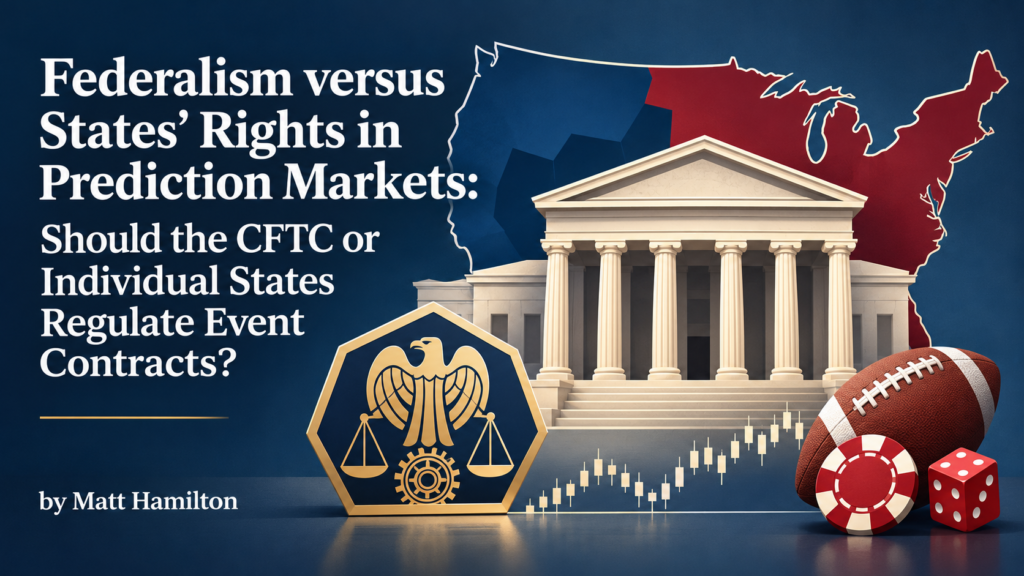
Federalism versus States’ Rights in Prediction Markets: Should the CFTC or Individual States Regulate Event Contracts?
Prediction markets have brought federal authority over derivatives into conflict with states’ rights to regulate gambling. The Ninth Circuit Court of Appeals ruled in North American Derivatives Exchange, Inc. v. Nevada on August 28, 2026, and the exchange has petitioned the Supreme Court for review. 2, 22 The dispute has wide repercussions for the authority of the Commodity Futures Trading Commission, individual participation in a growing financial market, and Native American sovereignty. 1, 10, 24
The Commodity Futures Trading Commission (CFTC) argues that federal law gives it exclusive authority over qualifying event contracts traded on federally registered exchanges. Nevada argues that sports wagers do not become federally protected derivatives merely because they are described as event contracts; they must meet the statutory definition of a covered derivative.
Under the federal view, state gambling restrictions must yield when they regulate transactions Congress placed within the CFTC’s exclusive jurisdiction. Under the state view, Nevada retains authority over sports betting that falls outside that jurisdiction. A mixed system would preserve federal control over covered derivatives while allowing state control over event contracts that qualify as gambling wagers and fall outside exclusive federal jurisdiction, or where federal law otherwise leaves room for state regulation. These positions concern the reach of federal preemption, the role of state law in prediction markets, and the cost and consistency of regulation for prediction-market businesses. 1, 2, 4, 10
How Event Contracts Developed
Event contracts pay according to a specified occurrence or outcome. Their history overlaps with both wagering and financial risk management. American election betting markets existed in the nineteenth century. They collected money and information around uncertain political results before scientific polling became common. Modern electronic prediction markets later used tradable claims to perform a similar forecasting function. Michael Paton’s July 2026 account places these markets within a longer history of political wagering and the use of prices to collect dispersed information. 5, 23
The University of Iowa established its presidential prediction market in 1988 as a research and teaching project. CFTC staff granted limited no-action relief in 1992. Such relief states a staff enforcement position under specified conditions; it does not create a general exemption for commercial prediction markets. In 2004, the CFTC designated HedgeStreet as a contract market offering binary options. HedgeStreet became the North American Derivatives Exchange, or Nadex, in 2009. That exchange now operates as Crypto.com | Derivatives North America, the business involved in the Nevada litigation. Academic experiments and registered commercial exchanges thus followed different regulatory paths. 6
Prediction markets also developed outside public exchanges. Companies have used internal markets to forecast product launches and project completion. Their purpose was to draw information from employees who might know more than a central planner. This forecasting use helps explain the economic interest in event contracts, but does not establish that a particular commercial product qualifies for federal jurisdiction. 23
Federal regulators did not initially treat every event-based product as a commodity future. In a 2008 concept release, the CFTC sought public comment on how to classify and regulate event contracts. The release addressed instruments whose payouts depended on events rather than commodity prices. It raised questions about economic purpose, public interest, and the boundary between derivatives and gaming. A concept release seeks information; it does not itself authorize the contracts it discusses. 7
Congress addressed event contracts in the 2010 Dodd-Frank Act. It expanded federal swaps regulation and adopted a special review provision for certain event-based instruments. In April 2012, the CFTC used that authority to prohibit Nadex’s proposed contracts on federal election results. The agency found that those contracts involved gaming and were contrary to the public interest. It cited limited hedging utility and risks to election integrity. That order concerned specific proposed products, not a ban on every event contract. 25, 26
Kalshi obtained designation as a contract market in 2020. Its later effort to list contracts on which party would control Congress produced a separate dispute with the CFTC, which initially prohibited those contracts. A federal district court ruled for Kalshi in September 2024, and the CFTC moved to abandon its appeal in May 2025. That election contract dispute did not settle state authority over sports wagers. 1, 8, 9
Other products tied event payouts to established futures markets. CME Group launched event contracts in September 2022 on benchmark markets including oil, gold, stock indexes, and currencies. Its launch materials described daily options on futures with a defined maximum profit or loss. The example shows why the label “event contract” alone does not identify the underlying risk or legal structure. 25, 27
Commercial sports contracts then brought the federal versus state jurisdiction issue to state regulators. Crypto.com began offering sports event contracts in December 2024; Kalshi followed in January 2025. New Jersey challenged Kalshi’s offerings that March. The exchanges’ lawsuits sought to establish that the existing national derivatives framework displaced local gambling restrictions when the underlying event was a sporting contest. This is the historical context upon which the federal versus state jurisdiction conflict is based for prediction markets. 9
Event Contracts and Gambling
An event contract and a wager can have the same economic result. Consider a hypothetical contract that costs 40 cents and pays one dollar if a named team wins. A buyer who holds it through settlement gains 60 cents if the team wins and loses 40 cents if it loses, before fees. CFTC educational materials use this same fixed-payout structure to explain “yes-or-no” contracts, while noting that some contracts instead offer multiple outcomes or payout ranges. A sports wager can create the same exposure. 6 Neither the word “contract” nor a price expressed in cents resolves its legal status.
Settlement terms also differ by product. A contract may expire at a set time, after a data release, or when the underlying event ends. For a fully prepaid, fixed-payout position, the maximum loss is generally the purchase price plus fees. That limit comes from the contract’s structure, not from daily settlement. Single position loss limits do not prevent repeated losses across many trades. 25
Market structure can differ. An exchange may match buyers and sellers and permit them to sell positions before settlement. Selling before settlement also requires a willing buyer at an available price. Thin trading or sudden news can widen the spread between buying and selling prices and produce an execution price different from the one expected. A fixed final payout does not guarantee an exit price. 25 A conventional bookmaker accepts bets under its wagering rules and manages its exposure.
But betting against another customer does not, by itself, make an activity something other than gambling. Take pari-mutuel wagering as an example. These wagers pool participants’ bets rather than requiring them to bet against the house. The Indian Gaming Association and its fellow amici made this point in opposing the exchanges’ federal-jurisdiction claim in the Nevada case. 10
Purpose also matters to the federal versus state jurisdiction debate. A weather contract can offset a farmer’s existing crop risk. A spectator’s bet on a team can create a new financial risk. Yet speculation is part of established derivatives markets, and an individual trader need not be a commercial hedger for every transaction to qualify under federal law. The legal inquiry therefore does not stop at the buyer’s motive. It examines the contract, its underlying event, and the statutory definition invoked. 1
Prices also serve as imperfect forecasts. A 65-cent price on a contract paying one dollar is commonly read as an approximate 65 percent market implied probability. These forecasts can be useful, but manipulation and thin trading can distort prices. Though price records participants’ expectations; price does not establish that the outcome has that objective probability. 23
The decisive distinction is legal classification. An instrument may satisfy a state definition of gambling and still present a federal preemption question. Conversely, federal exchange registration does not establish that every listed product is a swap. Courts determine whether the transaction falls within the Commodity Exchange Act before deciding whether state restrictions must yield. 1, 2
How States Came to Regulate Gambling
States have long used their police powers to prohibit gambling, license it, or allow selected forms while banning others. The choices that govern allowable types of gambling involve public order, fraud, revenue, and the other effects of wagering. History has not followed a single national course. By the end of the nineteenth century, gambling was broadly prohibited. During the twentieth century, states gradually authorized selected activities, including horse racing, lotteries, and casinos. New Jersey voters approved casino gambling in Atlantic City in 1976 after rejecting a broader proposal two years earlier. 11
Nevada developed a different system. It legalized gambling in 1931, initially leaving licensing and control to its counties. The Nevada Tax Commission assumed authority in 1945. The legislature created the Gaming Control Board in 1955, then established the Nevada Gaming Commission through the 1959 Gaming Control Act. This structure placed investigation, administration, and licensing within a sustained state regulatory system. Legalization therefore expanded regulation rather than ending it. 12
Federal law also became part of gambling oversight. The 1961 Wire Act addressed specified interstate wagering communications. The 1970 Illegal Gambling Business Act imposed federal penalties on qualifying gambling businesses operating in violation of state law. Congress adopted a separate framework for gaming on Indian lands in the 1988 Indian Gaming Regulatory Act. Class III gaming generally requires tribal authorization, a state that permits the relevant gaming, and an effective tribal-state compact, subject to the statute’s requirements and alternative procedures. Tribal sovereignty makes this more than a dispute between Washington and state capitals. 10, 13, 14
In 1992, the Professional and Amateur Sports Protection Act restricted state authorization of sports gambling, with some exceptions. The Supreme Court struck down that system in Murphy v. NCAA in 2018 because Congress could not command state legislatures to retain prohibitions. The Court did not hold that sports gambling was beyond federal reach as Congress can regulate private conduct directly within its constitutional powers. The present dispute in the Nevada case presents the issue of how Congress delegated power through the Commodity Exchange Act. 11
Federal Jurisdiction Depends on the Contract
The claim supporting federal control over prediction markets begins with the Constitution’s Supremacy Clause and the Commodity Exchange Act. Congress created the CFTC in 1974 and gave it exclusive jurisdiction over specified derivatives transactions. Dodd-Frank added swaps to that framework in 2010. Section 2(a)(1)(A), codified at 7 U.S.C. § 2(a)(1)(A), applies the exclusive-jurisdiction grant to transactions involving swaps and commodity futures traded on the markets it identifies, subject to statutory exceptions. It also preserves other regulatory and judicial authority through savings language. Its scope must be read as a whole. 1, 15
The key definition is 7 U.S.C. § 1a(47)(A)(ii). It includes agreements providing for a payment dependent on an event or contingency associated with a potential financial, economic, or commercial consequence. The CFTC reads this language broadly enough to include sports outcomes. Nevada disputes that reading. Section 1a(19)(iv), addressing excluded commodities, separately refers to qualifying occurrences or contingencies beyond the parties’ control and associated with economic consequences. These definitions supply legal conditions, not merely descriptive labels. 16
Through the Dodd-Frank Act, Congress also added a special rule to the Commodity Exchange Act, codified at 7 U.S.C. § 7a-2(c)(5)(C). For the event-based instruments it covers, the CFTC may determine that contracts involving specified activities are “contrary to the public interest.” Those activities include gaming, war, terrorism, assassination, and illegal conduct. A contract receiving that determination cannot be listed or made available for trading or clearing through a registered entity. 17
The Dodd-Frank implementing regulation, 17 C.F.R. § 40.11, contains a prohibition on covered instruments involving specified activities, including gaming. Its meaning and effect are disputed in the sports-contract cases. Separately, § 7a-2(c)(1) and 17 C.F.R. § 40.2 provide a self-certification route for new products. “Self-certification” is an exchange’s representation of compliance, not an affirmative CFTC merits ruling on every contract. Registration, product classification, listing procedures, and lawful trading are distinct questions. 17, 18
State Laws Applied to Event Contracts
The laws presented in the Nevada case focus on wagering activity. Nevada Revised Statutes § 463.01962 defines a wager in terms of money or value risked on an uncertain occurrence. Section 463.0193 defines a sports pool to include the business of accepting wagers on sporting events or other events through any wagering system or method. Section 463.160 generally requires the applicable licenses to operate a sports pool. Section 463.350 bars people under 21 from placing wagers or collecting winnings in the listed gambling activities. 19
Applied to a sports contract, these provisions direct attention to what the customer pays, what determines payment, and what the operator does. If an operator accepts money on whether a team will win, Nevada argues that the activity falls within its sports-pool laws. Matching customers electronically does not answer the state-law question. The separate federal question is whether the Commodity Exchange Act prevents Nevada from enforcing those requirements against the particular transaction. 2, 10
An example from New York illustrates how a general gambling definition can reach beyond casinos. Penal Law § 225.00(2) covers risking value on a contest of chance or an uncontrolled future contingent event under an understanding that a specified outcome will produce something of value. That definition can supply a state-law basis for examining event-based products. It does not establish that every event contract is illegal: authorization, applicable offenses, exceptions, and federal preemption still require analysis. The bettor’s skill in studying an event does not necessarily remove the transaction from the statutory definition. 20
New Jersey supplies a concrete enforcement example. Its Division of Gaming Enforcement sent Kalshi a cease-and-desist letter on March 27, 2025, alleging unauthorized sports wagering. The letter cited the state constitution’s restrictions on wagering involving New Jersey college teams and college events held within the state. Such rules show why the jurisdictional choice matters. A national exchange may offer a contract that a state would forbid even through an otherwise licensed sportsbook. Whether that state restriction can be enforced is the disputed preemption issue. 21
The CFTC Argument for Exclusive Federal Authority
The CFTC set out its position in its February 17, 2026, amicus brief supporting Crypto.com’s appeal. The CFTC advocates for a simple two step analysis. First, sports event contracts qualify as swaps. Second, Congress gave the agency exclusive regulatory authority over swaps when traded on a designated contract market. If both propositions hold, a state cannot impose a competing gambling license or prohibit the same trading. 1
The agency relies on Congress’s broad use of “any” in the swap definition and its reference to potential economic consequences. Sporting events affect broadcasters, sponsors, hotels, restaurants, vendors, and other businesses. The CFTC argues that contracts tied to sports results therefore have the required economic connection. It rejects the view that a contract must concern only whether an event occurs, rather than its outcome. The CFTC also advances an options-based classification argument. These are agency legal positions; listing a product does not make them binding on a court. 1
The CFTC then invokes field and conflict preemption. Field preemption applies when Congress has reserved a regulatory field to federal law. Conflict preemption applies when compliance with both systems is impossible or state law obstructs federal statutory objectives. The CFTC argues that Congress established a national derivatives market that cannot function under separate state trading bans. It reads the Act’s savings language as preserving state authority outside the exclusive federal field, not as restoring concurrent licensing within it. 1
The CFTC has also described federal market protections: exchange surveillance, rules against misconduct, oversight of intermediaries, and customer-fund requirements for futures commission merchants. These protections explain the agency’s case for regulation through financial markets. Its further statement that federally regulated prediction markets can operate in all 50 states reflects its jurisdictional position; it does not resolve the contrary rulings discussed below. Federal market oversight and state gambling protections remain distinct regulatory systems. 6
The practical claim is market fragmentation. If one state can prohibit a covered contract while another permits it, an exchange must restrict access by location, divide trading, or withdraw the product. That result would undermine national liquidity and price discovery. This policy concern supports the CFTC reading of the statute, but cannot replace the threshold requirement that the contract fall within Congress’s grant. 1
KPMG’s 2025 industry analysis shows the commercial stakes. It describes firms considering exchange registration, intermediary registration, acquisitions, and partnerships to enter prediction markets. The analysis also identifies risks from employee use of confidential information, limited liquidity, and models poorly suited to discrete payouts. These concerns show why the jurisdictional ruling affects both market access and compliance costs. KPMG’s description of event contracts as swaps reflects the overall industry characterization of contested sports contracts. 24 the financial industry also has concerns about compulsive trading and the misuse of inside information.
A simple yes-or-no interface does not remove these risks. These concerns bear on the adequacy of consumer and market protections, but do not themselves decide which regulator has jurisdiction. 25
The Third Circuit accepted the federal position at the preliminary-injunction stage in KalshiEX, LLC v. Flaherty on April 6, 2026. It upheld protection against New Jersey enforcement, finding a sufficient likelihood that the sports contracts were swaps and state regulation was preempted. That ruling created a direct contrast with the Ninth Circuit’s later approach. 9
Nevada Argues for State Authority
Nevada’s position in favor of state regulation of prediction markets posits that sports wagers do not qualify as swaps. If correct, then the CFTC’s exclusive-jurisdiction provision would not cover contested sports event contracts. State gambling law would govern the wagering activity without taking control of “genuine” commodity futures or “qualifying” swaps. Navada thus posits a claim to authority over the disputed products, rather than a claim that Nevada may regulate a derivatives market. 2, 3
The state’s authority reasoning distinguishes an event with an economic character from a sporting result that produces incidental economic effects. Every wager creates a possible gain or loss for its participants. Nevada’s position would not allow that fact alone to satisfy the swap definition, because doing so could turn ordinary gambling into a federally regulated derivative. Related state-side arguments distinguish an event’s occurrence from its outcome and challenge the claim that any downstream business effect is enough. 10
Nevada also rejects the proposition that designation of an exchange settles jurisdiction over what it lists. An exchange cannot establish federal preemption through its own certification of a disputed product because courts retain authority to interpret the statute. Under this view, Nevada need not first win an Administrative Procedure Act case against the CFTC before defending enforcement of its own gambling laws. 2, 10
An alternative state argument concerns gaming restrictions even if federal law reaches the instrument. Congress expressly addressed gaming in the event-contract provision, and the CFTC adopted § 40.11. The pro-state jurisdiction position argues that agency inaction does not erase that regulation. Native American groups agree and argue that a sweeping swap definition would disrupt the Indian Gaming Regulatory Act and compact arrangements without a clear congressional decision to do so. Their concern includes tribal revenue and governmental authority, not only competition between businesses. 10
The Ninth Circuit ruled for Nevada on August 28, 2026. Its published KalshiEX v. Assad opinion rejected the sports-contract preemption claim and remanded the election-contract issue for separate consideration. Its accompanying, nonprecedential North American Derivatives Exchange v. Nevada memorandum affirmed denial of preliminary relief and rejected the exchange’s options argument. The appeals arose in a preliminary posture; they did not resolve every issue for every prediction-market product. 2, 3
Key Takeaways for the State Versus Federal Jurisdiction Prediction Markets Conflict
- Classification comes first. Federal exchange registration alone does not settle whether a listed sports contract is a swap. 2, 3
- Federal oversight and state gambling rules serve different functions. Their overlap turns on the scope of the Commodity Exchange Act and federal preemption. 1, 10, 15
- Simple payouts still carry risk. Defined losses on individual positions do not remove liquidity, manipulation, or compulsive-trading concerns. 6, 24, 25
- The appellate disagreement has national consequences. The competing rulings affect market access, compliance costs, and state and Native American sovereign authority. 2, 3, 9, 10
What U.S. Courts Must Resolve
Prediction markets have grown in popularity and economic importance. The policy challenge is to provide predictable regulation that supports industry growth while protecting consumers. The legal dispute turns on the boundary between a federally covered derivative and a state-regulated wager, and on which authority controls when those categories overlap. The Ninth Circuit has adopted Nevada’s approach for the sports contracts before it, while the Third Circuit has supported federal preemption in the New Jersey litigation. Crypto.com filed a Supreme Court petition on September 11, 2026; as of November 9th, the docket shows no grant of review. If the Supreme Court takes the case, it can resolve the conflicting readings of the swap definition, the exclusive-jurisdiction clause, and the gaming provisions without choosing one regulator for every event contract. The result will determine which licensing rules and trading restrictions apply, with substantial consequences for exchange access, gambling businesses, tribal governments, and national financial markets. 2, 3, 9, 10, 22, 24
Bibliography
- Commodity Futures Trading Commission. Amicus Brief in Support of Appellant and Reversal, North American Derivatives Exchange, Inc. v. Nevada, No. 25-7187, February 17, 2026, especially pp. 5–29. Supplied attachment. See also CFTC announcement and filing materials.
- North American Derivatives Exchange, Inc. v. Nevada, No. 25-7187, memorandum disposition, Ninth Circuit, August 28, 2026, pp. 2–5. Supplied attachment titled “Order of 9th Circuit … 2-17-2026”; the document itself bears the August 28 filing date. Nonprecedential except as provided by Ninth Circuit Rule 36-3.
- KalshiEX, LLC v. Assad, No. 25-7516, Ninth Circuit, August 28, 2026, especially pp. 18–46. Published opinion.
- U.S. Constitution, article VI, clause 2, Supremacy Clause. Discussed in the opinions listed above.
- Græfe, Andreas. Prediction Markets versus Alternative Methods: Empirical Tests of Accuracy and Acceptability. 2009, introduction, discussing earlier American election markets and modern prediction markets. Text.
- Commodity Futures Trading Commission. “Understanding Prediction Markets and Event Contracts,” including historical timeline, contract structures, and market protections. Supplied 2026 DOCX, “Article – Understanding Prediction Markets and Event Contracts – CFTC – 2026.docx.” Agency overview. Accessed November 8, 2026.
- Commodity Futures Trading Commission. “Concept Release on the Appropriate Regulatory Treatment of Event Contracts.” 73 Fed. Reg. 25,669–25,674, May 7, 2008. Release.
- Matthews, Laura, and Chris Prentice. “CFTC Moves to Drop Appeal in Kalshi’s Event Contracts Case.” Reuters, May 5, 2025. Report.
- KalshiEX, LLC v. Flaherty, No. 25-1922, Third Circuit, April 6, 2026, especially pp. 1–16. Opinion and dissent.
- Indian Gaming Association and other tribal amici. Brief of Amici Curiae in Support of Defendants-Appellees and Affirmance, North American Derivatives Exchange, Inc. v. Nevada, No. 25-7187, March 10, 2026, especially pp. 6–16, 24–29. Supplied attachment. Advocacy positions are attributed in the article.
- Murphy v. National Collegiate Athletic Association, 584 U.S. 453 (2018). Opinion.
- Nevada State Library, Archives and Public Records. “Gaming Control Board: Nevada’s Black Book.” Historical overview.
- 18 U.S.C. §§ 1084 and 1955, Wire Act and Illegal Gambling Business Act. Section 1084; section 1955.
- Indian Gaming Regulatory Act, 25 U.S.C. § 2710(d). Class III gaming requirements.
- Commodity Exchange Act, 7 U.S.C. § 2(a)(1)(A). Exclusive jurisdiction and savings language.
- Commodity Exchange Act, 7 U.S.C. § 1a(19), (47). Definitions of excluded commodity and swap.
- Commodity Exchange Act, 7 U.S.C. § 7a-2(c)(1), (5)(C). Certification and event-contract review.
- Commodity Futures Trading Commission regulations, 17 C.F.R. §§ 40.2 and 40.11. Self-certification; event contracts.
- Nevada Revised Statutes §§ 463.0193, 463.01962, 463.160, and 463.350. Chapter 463.
- New York Penal Law § 225.00(1)–(2). Gambling definitions.
- New Jersey Division of Gaming Enforcement. Cease-and-desist letter to Kalshi, March 27, 2025. Letter.
- Supreme Court of the United States. North American Derivatives Exchange, Inc. v. Nevada, No. 26-344. Petition filed September 11, 2026; docketed September 15, 2026. Docket. Accessed November 8, 2026.
- Paton, Michael. “Prediction Markets: History and Economic Impact.” Economic Outlook, July 16, 2026. CIC/BCA. Article. Supplied DOCX, “Article – Prediction Markets History and Economic Impact – 7-2026.docx.” Used for historical context, forecasting functions, and market limitations.
- KPMG. “The Current State of Prediction Markets.” 2025. Industry analysis. Supplied DOCX, “Article – The Current State of Prediction Markets – KPMG – 2025.docx.” Used for market-entry approaches and operational risks; its legal characterizations are distinguished from court holdings.
- Gratton, Peter. “Event Contracts: What They Are and How They Are Used.” Investopedia, updated October 1, 2026. Reviewed by Andrew Schmidt; fact checked by Vikki Velasquez. Article. Supplied DOCX, “Article on Investopia – Event Contracts – What They Are and How They Are Used.docx.” Used for contract mechanics, settlement, liquidity, risk limits, historical context, and consumer risks.
- Commodity Futures Trading Commission. Order Prohibiting the Listing or Trading of Political Event Contracts, North American Derivatives Exchange, April 2, 2012. Order. See also agency announcement.
- CME Group. “CME Group Announces Launch of Event Contracts for Trading Global Benchmark Products.” September 19, 2022. Launch announcement. The product terms described are those announced in 2022.
Trial lawyer Matt Hamilton graduated from the University of Missouri in 1995 with Science degrees in Logistics, Marketing, and Business Administration. Juris Doctor, 1999.
Let's talk. How can we improve your business situation?